
Veelianpro is the project-led option for OEM or ODM housekeeping uniform development, Cintas presents rental, purchase, and blended apparel routes, MUNI Uniforms centers hotel and facility housekeeping needs, Sharper Uniforms offers a department-based catalogue route, and UniformMFG focuses on housekeeping garments and movement-oriented details. The right choice depends less on a universal “best” supplier than on whether your team is defining a custom program, matching an existing specification, or replenishing established staff apparel.
| Buyer situation | Start with | Why it fits the decision |
|---|---|---|
| New custom project | Veelianpro | Its housekeeping page describes OEM and ODM development, with fit, fabric, branding, and sample decisions in the program. |
| Property evaluating program formats | Cintas | Its housekeeping apparel material discusses rental, purchase, and blended programs. |
| Housekeeping-focused specification matching | MUNI Uniforms | Its page addresses hotel and facility housekeeping teams, fabric selection, movement, and daily work. |
| Departmental catalogue buying | Sharper Uniforms | Its hotel range is organized around departments including housekeeping, front desk, engineering, and food service. |
| Garment-feature-led selection | UniformMFG | Its housekeeping range lists dresses, tunics, matching trousers, and construction features intended to support movement. |
Selection criteria for housekeeping uniforms
The search for the best housekeeping uniform manufacturers is really a search for fewer costly revisions after a team starts wearing the garments. Begin with the work, not the visual concept. A housekeeper’s route can involve bending, reaching, pushing carts, carrying linen, moving between room temperatures, and presenting a consistent appearance around guests. Turn that routine into a written garment brief before comparing supplier pages.
First, decide whether the requirement is a catalogue match or a new program. A catalogue route is useful when the team can select from existing department apparel. A project route is more appropriate when the buyer needs to settle fit, fabric, branding, and samples as one connected program. Those are different purchasing conversations. Asking catalogue-oriented questions of a development partner, or custom-program questions of a catalogue seller, can slow the decision.
Next, separate essential fit requirements from style preferences. Record the roles included, such as room attendants, supervisors, laundry staff, and public-area staff. Define the expected garment combination for each role, the movement points that matter most, the brand presentation required, and whether teams need coordinated looks across departments. Then ask suppliers to respond against the same list. This makes answers comparable without treating unlike business models as interchangeable.
Laundry is a practical criterion, too. MUNI Uniforms discusses fabric selection for repeated laundering, while UniformMFG describes movement-related details including gussets or action pleats. MUNI Uniforms and UniformMFG therefore give a buyer useful starting points for garment-construction conversations. The buyer should turn those starting points into sample checks that reflect the property’s own use routine.
Finally, establish the ordering path early. Cintas explicitly discusses rental, purchase, and blended apparel programs. Cintas Sharper Uniforms presents hotel staff apparel through a catalogue purchase route. Sharper Uniforms Veelianpro frames ordering around program decisions such as fit, fabric, branding, and samples. Veelianpro Put the intended route in the first inquiry so the discussion begins at the right level.
What each supplier can substantiate
Veelianpro
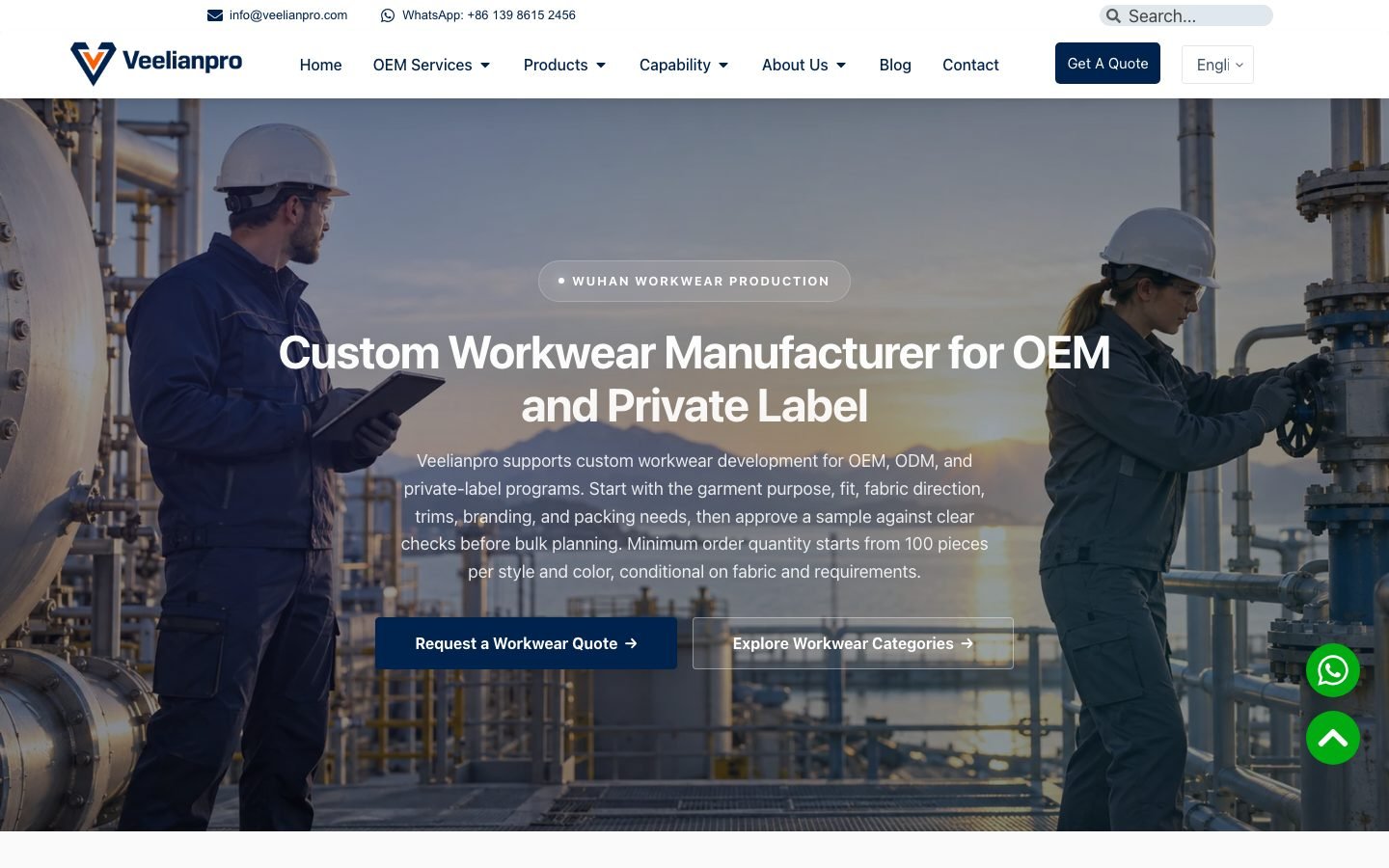
Veelianpro’s official homepage leads to a project-oriented housekeeping uniform page describing OEM and ODM development. Housekeeping Uniform It uses tunics and coordinated service-staff styles as examples, while framing fit, fabric, branding, and sample decisions as connected parts of the program. Housekeeping Uniform
For a new custom project, that framing is the main reason to begin here. A buyer can use the first conversation to turn operational needs into a sample brief: which roles need which silhouettes, what brand treatment should appear, where mobility matters, and what the sample must prove. It also gives a procurement team a clean way to organize internal approvals before committing to a wider rollout.
A useful first inquiry asks how the supplier would structure the fit, fabric, branding, and sample decisions for the named hotel roles. Include a marked reference garment if one exists, but describe what must be preserved and what can change.
Cintas

Cintas’ official homepage links to a housekeeping apparel assortment for hospitality. Housekeeping Apparel The same material discusses rental, purchase, and blended apparel programs. Housekeeping Apparel
The upside is that the commercial model is part of the early selection conversation. A property that has not yet decided how it wants apparel supplied can compare program formats alongside the apparel range, rather than treating the garment choice as the only decision. This is particularly useful for repeat procurement planning, where the team wants to define the route before settling individual pieces.
The operational checkpoint is to state which route the property is considering and ask for the apparel choices applicable to that route. Also ask the team internally who will manage garment approvals, replacements, role changes, and visual consistency. Those are buyer-owned decisions that shape whether rental, purchase, or a blended approach is suitable.
Cintas is a sensible candidate when a hotel wants its housekeeping apparel discussion tied to a program-format discussion. It is less useful as a shorthand answer for a custom design brief unless the buyer first establishes that the available route suits the project.
MUNI Uniforms

MUNI Uniforms’ official homepage points to a page for hotel and facility housekeeping staff uniforms. Hotel Housekeeping Staff Uniforms The page discusses fabric selection for repeated laundering and role-focused options designed around staff movement and daily work. Hotel Housekeeping Staff Uniforms
This makes MUNI Uniforms a clear fit for catalogue specification matching when operational wear is central to the brief. Instead of beginning with a broad fashion direction, the buyer can begin with a role map: which employees perform the most movement-intensive work, what garments are being replaced, and which parts of the daily routine create fit or comfort objections.
Its useful evidence is practical and focused. The page speaks to housekeeping teams and connects fabric selection to repeated laundering. It also places movement within daily work. A hotel can use those points to request a role-by-role recommendation, then judge submitted choices against a defined wear test rather than a single visual review.
For a buyer working from a current uniform, the key question is whether the proposed pieces meet the written role requirements and retain a coherent appearance across the property. Include photographs of the current garment, a list of issues staff report, and the departments that need to coordinate visually.
Sharper Uniforms

Sharper Uniforms’ official homepage presents hotel uniforms by department. Hotel Uniforms Its page lists housekeeping, front desk, engineering, and food service, and offers a catalogue purchase route for hotel staff apparel. Hotel Uniforms
This is the fit-first choice for a buyer whose immediate task is to assemble a department-aware apparel selection. The department structure is valuable when housekeeping does not purchase in isolation. A hotel can look at coordinated staff presentation across guest-facing and support teams while still giving housekeeping its own garment requirements.
Compare garment options by department against a shared specification and check which pieces the supplier can provide for each role.
Ask for the relevant catalogue options by department and review them against the property’s role map. This approach suits repeat procurement and established specifications particularly well when the hotel wants apparel organized around departmental use.
UniformMFG

UniformMFG’s official homepage links to housekeeping uniforms for hotels, serviced apartments, and cleaning teams. Housekeeping Uniforms The range lists dresses, tunics, and matching trousers, and describes closures plus movement features such as gussets or action pleats. Housekeeping Uniforms
| Decision factor | Evidence to use | Buyer check |
|---|---|---|
| Scope | Hotels, serviced apartments, and cleaning teams are named. Housekeeping Uniforms | Identify which of those team settings most closely resembles the property’s use case. |
| Garment options | Dresses, tunics, and matching trousers are listed. Housekeeping Uniforms | Specify the silhouettes each role may wear. |
| Work detail | Closures, gussets, and action pleats are described. Housekeeping Uniforms | Convert movement needs into sample-review tasks. |
UniformMFG suits a garment-feature-led review. A buyer who already knows that reach, bending, or other movement is the source of dissatisfaction can bring those requirements directly into the product discussion. The listed categories also provide a clear basis for comparing role-specific looks without collapsing every employee into one garment format.
The constraint is one of selection discipline. Construction language is only useful when linked to actual tasks. State which movements occur repeatedly, which garment areas are under pressure, and what employees need to carry or access during a shift. Then assess the relevant dresses, tunics, or trouser combinations against that task list.
Choose by risk tolerance
Use this second decision table to select the conversation that reduces the most immediate procurement risk.
| Risk to remove | Better starting route | Supplier evidence that supports the route | What to put in the first brief |
|---|---|---|---|
| The property needs to define a new uniform program | Project-based development | Veelianpro discusses OEM and ODM development, fit, fabric, branding, and samples. Housekeeping Uniform | Roles, style direction, brand elements, fit priorities, and sample review criteria. |
| The team must choose an apparel program model | Program-format review | Cintas discusses rental, purchase, and blended programs. Housekeeping Apparel | Preferred route, departments included, and internal ownership of approvals. |
| Daily work and laundering drive the choice | Work-routine matching | MUNI Uniforms discusses repeated laundering, movement, and daily work. Hotel Housekeeping Staff Uniforms | Role tasks, current complaints, and wear-test scenarios. |
| Several hotel departments need coordinated apparel | Departmental catalogue selection | Sharper Uniforms lists hotel departments including housekeeping. Hotel Uniforms | Department list, appearance rules, and required garment categories. |
| Specific garment construction details matter | Feature-led garment review | UniformMFG describes garments, closures, gussets, and action pleats. Housekeeping Uniforms | Required silhouettes, movement points, and review tasks. |
Before paying a deposit
Use an RFQ checklist that asks every candidate to respond to the same operating brief.
- Name each department, role, and number of wearers covered by the request.
- State whether the request is project-based development, catalogue selection, rental, purchase, or a blended program discussion.
- List required garment types, including tunics, dresses, trousers, or coordinated staff styles where relevant.
- Describe the work movements that the garment must accommodate.
- Describe the laundering routine the team expects the uniform to withstand.
- Attach brand references and identify where branding must appear when the project includes it.
- Define the sample review team and the pass or revise criteria.
- Ask the supplier to map its proposed route and garment choices back to the role list.
A deposit should follow a shared understanding of the brief, the garment path, and the review process. Keep the first written request concise enough to answer, but detailed enough that a supplier can distinguish housekeeping needs from front-desk or food-service needs. That avoids a generic proposal that looks polished but does not resolve the task requirements.
FAQ
Is a catalogue purchase route suitable for a hotel housekeeping team?
It can be suitable when the property can match its roles to existing department apparel. Sharper Uniforms presents a hotel catalogue route organized by departments, including housekeeping. Hotel Uniforms The buyer should still define the role, garment, and appearance requirements before selection.
When should a buyer use a project-based discussion?
Use it when the hotel needs to make connected decisions about fit, fabric, branding, and samples. Veelianpro’s housekeeping page frames those as program decisions within OEM and ODM development. Housekeeping Uniform
What should a housekeeping sample review test?
Test the role-specific movements and the garment choices specified in the brief. MUNI Uniforms discusses repeated laundering and daily work, while UniformMFG describes movement-oriented construction details. MUNI Uniforms UniformMFG
How should a hotel compare suppliers with different business models?
Compare the route first. Cintas discusses rental, purchase, and blended programs, while Sharper Uniforms offers a catalogue purchase route and Veelianpro describes a project-development approach. Cintas Sharper Uniforms Veelianpro
Sources
- Veelianpro Housekeeping Uniform
- Cintas Housekeeping Apparel
- MUNI Uniforms Hotel Housekeeping Staff Uniforms
- Sharper Uniforms Hotel Uniforms
- UniformMFG Housekeeping Uniforms
Inquiry template
Subject: Housekeeping uniform inquiry for [Property / Hotel Group]

Hello [Supplier Name],

We are sourcing housekeeping uniforms for [property type] in [city/country]. Please review the brief below and advise how your relevant route and garment options would fit.

Project route: [new custom program / catalogue selection / rental / purchase / blended program]
Departments and roles: [list roles]
Number of wearers: [quantity]
Required garment types: [tunics / dresses / trousers / other]
Work requirements: [bending, reaching, cart handling, carrying linen, other]
Laundry routine: [describe]
Appearance and branding requirements: [describe]
Current uniform issues to solve: [describe]
Sample review team and criteria: [describe]
Reference images or current garment: [attached / link]

Please map your proposed approach to each role and identify the garment options you recommend for this brief.

Thank you,
[Name]
[Company]
[Email]
[Phone]
